
Our Expert in Montenegro
No results available
Legalization of real estate montenegro has become one of the most consequential compliance issues facing property owners, foreign buyers, developers and lenders heading into 2026. As Montenegro intensifies its effort to bring informally built structures into the formal legal and cadastral framework, assets that cannot be brought into compliance risk fines, demolition orders and severe restrictions on transfer and financing. This guide explains, in practical terms, who and what can be legalized, the procedural steps involved, the municipal timelines that apply, how cadastre registration is affected, and what each party to a transaction must verify before committing capital. It is written for a business and legal readership that needs clear, actionable answers rather than generalities.
In short: This guide covers who and what qualifies for legalization of real estate montenegro in 2026, the step-by-step procedure, municipal deadlines and enforcement, the effect of legalization on cadastral title and mortgages, and the due-diligence steps buyers, sellers, developers and lenders must take to avoid transactional risk.
“Legalization” in Montenegro refers to the formal administrative process through which a building constructed without the required permits, or in departure from an approved permit, is brought into legal compliance and entered into the official records. It is distinct from obtaining a standard construction or occupancy permit for a new, lawfully commenced project. Legalization is remedial: it addresses structures that already exist on the ground but lack a complete and valid legal basis.
The policy drivers behind the current legalization push are consistent and well understood. The state seeks to regulate a property market long affected by informal construction, to restore public order in spatial planning, to expand the tax and cadastral base, and to protect sensitive areas, particularly the coastline and designated conservation zones. For owners, the significance is fundamental: without legalization, title to an informal building is incomplete, its value is depressed, and its marketability and financeability are compromised.
The legal framework for building legalization montenegro is set out in primary legislation enacted and amended by the national parliament and published in the Official Gazette of Montenegro (Službeni list). Because the governing statute and its amendments, including the operative 2025–2026 deadlines, are published there, the Official Gazette is the authoritative source for the exact law number, article references and formal cut-off dates. Owners and advisers should always verify the current text and any pending amendments before acting, as deadlines and eligibility criteria can be adjusted by subsequent amendment.
Eligibility turns on whether a structure can be reconciled with the applicable spatial and urban planning documents and with technical safety standards. In broad terms the categories commonly encountered are:
The decisive question for any asset is whether it is “capable of being brought into legal compliance”, meaning it sits on land where such a structure is permissible under the planning framework, meets structural safety requirements, and does not fall within a category or zone where legalization is excluded. Structures in protected coastal or conservation zones face the most restrictive treatment.
The single most time-sensitive element of montenegro property legalization 2026 is the deadline regime. Where the statute fixes a cut-off for submitting a legalization application, missing it can foreclose the remedy entirely and expose the owner to enforcement. Because the precise dates are set by the legalization law and its amendments in the Official Gazette, every owner and prospective buyer should confirm the current deadline against the published text before relying on any secondary summary. Early action is strongly advisable: applications require technical documentation that takes time to prepare, and queues at busy municipalities lengthen as deadlines approach.
Although the enabling law is national, implementation is largely municipal, and this is where permitting and planning montenegro becomes genuinely variable. Municipalities administer applications against their own local spatial and urban plans, which define what may be built where and in what volume. Practical differences between municipalities typically include:
Coastal municipalities, which attract the heaviest development pressure, generally apply the closest scrutiny, particularly for structures near the shoreline. Confirming the position with the relevant municipal authority, rather than assuming a uniform national practice, is essential to an accurate assessment.
Failing to legalize an eligible structure within the applicable window carries serious and escalating consequences. The legalization framework provides for enforcement measures that can include monetary penalties and, in the most serious cases, demolition orders against unlawful construction. Beyond direct enforcement, non-legalized status undermines the owner’s position in the market: transfer of an informal building is restricted and complicated, banks will not readily accept it as mortgage security, and buyers’ lawyers will flag it as a material defect. In practice, the inability to complete a sale or to refinance can be as damaging commercially as any fine.
The legalization pathway follows a recognisable sequence from eligibility assessment through to cadastre registration. While exact documentation varies by municipality, the core stages are consistent. A disciplined, properly sequenced approach shortens the overall timeline and reduces the risk of refusal.
The technical component is the substance of a legalization application. It typically requires a geodetic survey locating the structure on the parcel, architectural drawings showing the as-built condition, and a structural assessment confirming that the building is sound and safe for use. These documents must be prepared and certified by licensed professionals, an authorised surveyor, architect and structural engineer as applicable. Deficiencies in the dossier are the most common cause of delay, so early engagement of qualified experts is a false economy to skip.
The application is lodged with the competent authority along with proof of ownership or possession, the technical dossier and payment of the applicable fees. The authority may publish or process the application in accordance with the applicable procedure and may issue requests for supplementation. Keeping clean, dated copies of every filing and every official communication is important, both for managing the process and for later due diligence when the property is sold.
Where the authority is satisfied that the structure conforms to the planning framework and meets technical standards, it issues the legalization decision. This document is the keystone of the whole exercise: it is the formal recognition that the previously informal building has a valid legal basis, and it is the instrument on which cadastre registration and, ultimately, financeability and marketability depend.
When to involve a lawyer and engineer: Engage counsel at the eligibility-check stage, before filing, so that planning viability, title and deadline exposure are assessed together. Instruct the surveyor, architect and structural engineer in parallel so the technical dossier is ready to file. Early professional involvement is the single most reliable way to avoid refusal and lost time.
Legalization is not complete until the structure is reflected in the cadastre. Cadastre registration montenegro is the step that converts a favourable decision into a secure, transferable and financeable legal position. The real estate cadastre in Montenegro is maintained by the Real Estate Administration (Uprava za nekretnine). Until the legalized building is correctly entered in the cadastral register against the parcel, the owner’s title remains incomplete in the public record, and the practical benefits of legalization, clean transfer and mortgageability, are not yet available.
Updating the cadastre generally requires the legalization decision, the certified geodetic survey and supporting ownership documentation. The most frequent problems arise from:
Resolving these before or during registration avoids a situation where a building is legalized on paper but the cadastral entry remains defective, a combination that will stall any later sale or financing.
For lenders, a clean cadastral position is non-negotiable. Banks require that the security property, including any legalized structure, be correctly registered before they will register a mortgage and advance funds. A legalization decision that has not yet been carried through to the cadastre is, from a lender’s perspective, incomplete. Owners planning to refinance or to sell to a mortgage-financed buyer should therefore treat cadastre registration as part of the legalization project, not as an optional afterthought.
The legalization regime reshapes how transactions must be structured. Rigorous montenegro real estate due diligence is now essential whenever a target property includes any structure whose permit history is unclear. The core task is to establish, before exchange, whether every building on the land is legal, legalizable, or incapable of legalization, and to allocate the resulting risk expressly in the contract.
A practical due-diligence checklist for an acquisition should confirm:
Where a target depends on legalization, the sale and purchase agreement should address it head-on. In Montenegro, contracts for the transfer of real estate must generally be concluded in writing and notarised, and subsequent registration in the cadastre is required to perfect the buyer’s title. Common protective mechanisms include making completion conditional on the issue of the legalization decision and its cadastral registration, seller covenants to prosecute a pending application diligently, price retention or escrow of part of the purchase price pending registration, and liquidated-damages or price-adjustment clauses if legalization fails. Any such language should always be reviewed and tailored by Montenegro counsel before use.
Lenders will typically require, as a condition of drawdown, that the security property be fully legalized and registered, with the mortgage recorded against a clean cadastral entry. Buyers relying on bank finance should align their transaction timetable with the legalization and registration timeline, since a lender will not advance against an unresolved informal structure.
Two overlays complicate the standard picture: the rules governing foreign ownership and the heightened restrictions applying to the coast and conservation areas. Both interact directly with legalization, and both must be checked early.
Foreign buyers montenegro property acquisitions are permitted subject to conditions. Foreign natural and legal persons may generally acquire buildings, apartments and business premises in Montenegro, but certain categories of land, notably agricultural land, forests and land in some protected or border areas, are subject to restrictions or special conditions. Because specific restrictions and the acquisition procedure depend on the applicable legislation and current guidance, foreign buyers should confirm their eligibility for the particular asset, and the registration steps, before committing. Legalization status matters doubly here: a foreign buyer acquiring an informal structure inherits the legalization burden and should price and condition the deal accordingly.
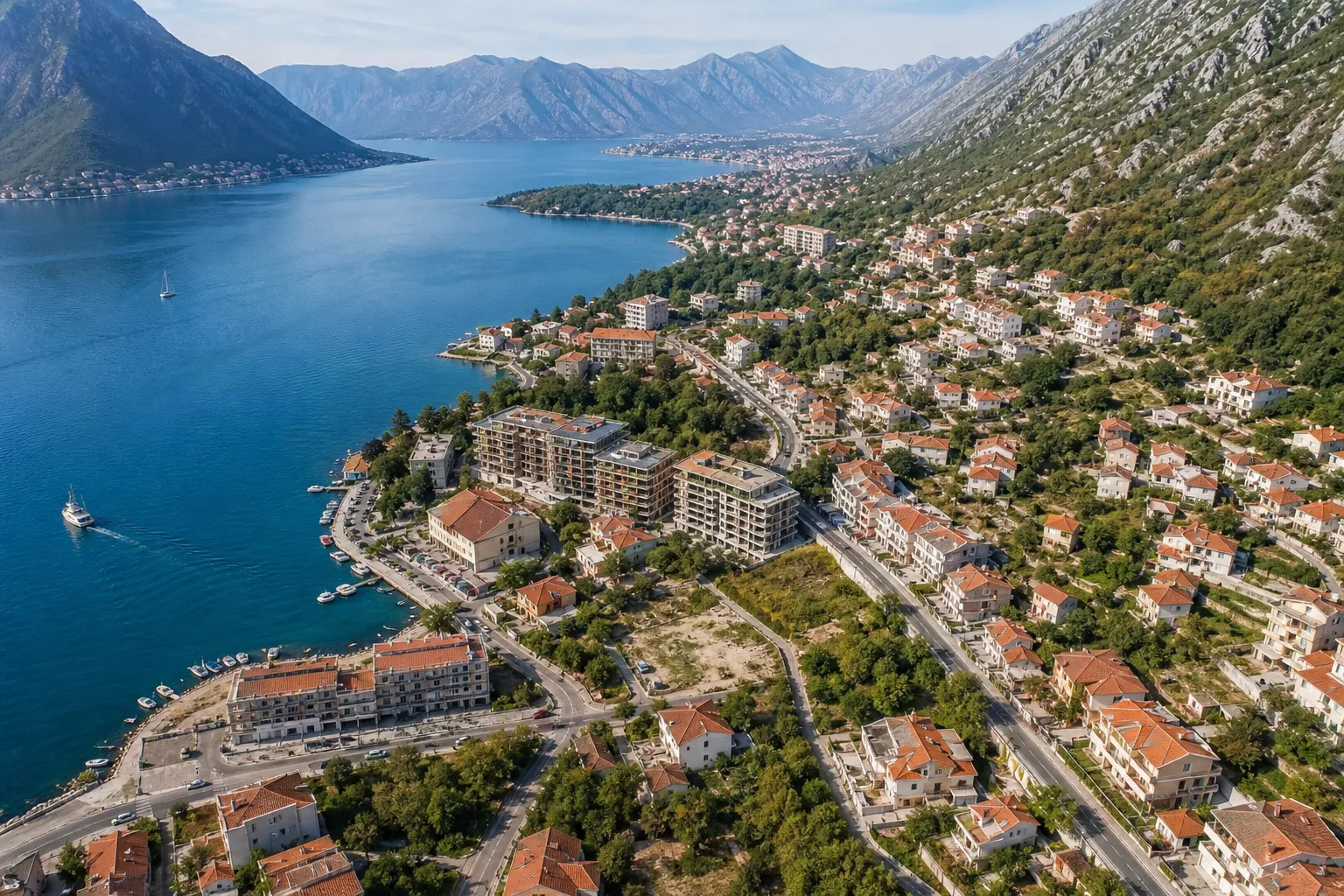
Coastal development rules montenegro are among the strictest in the system. The maritime domain (morsko dobro) along the coastline is a protected public resource managed by the responsible state body, and structures within coastal and conservation zones face significant limitations on legalization. In some cases legalization may be excluded entirely; in others it may require additional permits or compliance with special conditions. A coastal villa built without a permit therefore cannot be assumed to be legalizable simply because inland equivalents are, the zone-specific position must be verified against the planning documents and the relevant authority. This is the area where buyers most frequently overpay for assets that cannot be brought into compliance.
Timelines and costs vary considerably by municipality, by the complexity of the structure and by the completeness of the initial dossier. The figures below are indicative only and should be treated as estimates to be confirmed case by case with the competent authority.
| Stage | Typical activity | Nature of cost | Indicative duration |
|---|---|---|---|
| Eligibility and legal review | Planning check, title review, deadline assessment | Legal fees | Short, days to a few weeks |
| Technical dossier | Survey, drawings, structural report | Expert / professional fees | Weeks, depending on expert availability |
| Application and review | Filing, fees, administrative processing, supplementation | Administrative fees | Variable, subject to caseload |
| Cadastre registration | Entry of legalized structure, title update | Cadastral fees | Additional weeks after decision |
Regional variance is significant: busy coastal municipalities may take longer at the review stage than less pressured inland administrations. Build contingency into any transaction timetable that depends on completion.
| Property characteristic | Likely to be legalized? | Typical additional requirements | Buyer / developer impact |
|---|---|---|---|
| Residential house conforming to local plan | Yes | Standard technical dossier; survey and structural report | Generally proceedable; condition completion on registration |
| Enclosed terrace or added floor on legal building | Usually, if plan-compliant | Structural confirmation; updated drawings | Manageable; verify safety and plan limits |
| Commercial building in planned zone | Often, with scrutiny | Use, safety and planning compliance checks | Longer review; allow extra time and cost |
| Structure in protected coastal zone | Unlikely / restricted | Special permits; may be excluded entirely | High risk; do not assume value until confirmed |
| Building off-plan or on non-buildable land | No | Not reconcilable with planning framework | Demolition / enforcement risk; avoid acquisition |
Where legalization is unavailable or refused, the owner faces the enforcement machinery of the statute, which can include penalties and demolition orders for unlawful construction. Equally common are disputes that arise during the process itself, over eligibility, boundary discrepancies, or a refusal the owner considers unjustified. Understanding the routes for challenge is part of managing the risk.
A negative administrative decision is generally subject to challenge through the prescribed appeal route, with further recourse to the Administrative Court of Montenegro where the appeal is unsuccessful. Appeal rights operate to strict time limits, so a refusal demands prompt legal attention. Preserving the complete file, application, correspondence and the reasoned decision, is essential to mounting an effective challenge.
Not every dispute warrants litigation. Where a refusal rests on a curable deficiency, re-filing a corrected dossier or engaging with the authority may resolve matters faster and more cheaply than a contested appeal. Litigation is better reserved for genuine questions of law or for cases where the authority has misapplied the statute. For developer disputes, mediation and other alternative dispute resolution can preserve commercial relationships and timelines. Counsel should assess the merits and the commercial stakes before choosing a path.
The legalization of real estate montenegro rewards early, organised action. The following audience-specific checklists set out the priority steps and the right time to involve professional advisers.
For owners of informal structures:
For buyers:
For developers:
For related transactional support, consider engaging a qualified Montenegro real estate lawyer and commissioning detailed due diligence before preparing an acquisition.
The legalization of real estate montenegro is no longer a background formality, it is a live compliance issue that can determine whether an asset can be sold, mortgaged or lawfully retained. For owners, the message is to verify the applicable deadline now, assess eligibility early and carry the process through to cadastre registration. For buyers, sellers and lenders, the legalization of real estate montenegro must be built into due diligence, contract drafting and financing timetables, with particular caution around coastal and protected zones where legalization may simply be unavailable.
Because the governing law and its deadlines are fixed in the Official Gazette and implemented with local variation, every decision should rest on the current primary text and local confirmation rather than general assumption, and, given the transactional risk involved, on timely professional advice.
This article is general information and not legal advice. Consult a qualified Montenegro lawyer for advice on your specific property and transaction.
This article was produced by Global Law Experts. For specialist advice on this topic, contact Prelevic Law Firm, a member of the Global Law Experts network.

posted 53 minutes ago
posted 1 hour ago

posted 2 hours ago

posted 2 hours ago

posted 2 hours ago

posted 3 hours ago

posted 3 hours ago
posted 4 hours ago

posted 4 hours ago

posted 5 hours ago

posted 6 hours ago

posted 7 hours ago
No results available
Find the right Legal Expert for your business

Send welcome message